Acupuncture in Traditional Chinese Medicine
Traditional Chinese Medicine assumes that our life energy Qi flows through our body in channels. If the Qi is in flow, the person is healthy. Any disturbance of the Qi flow can lead to blockages in the body or to a deficiency in the meridians.
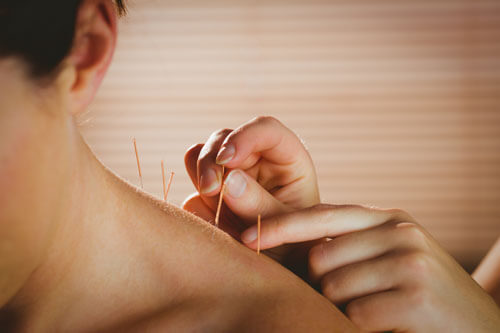
What exactly is acupuncture?
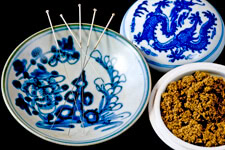
There are 361 known acupuncture points, which are located on different main channels and are connected to the internal organs. With the help of acupuncture needles, but also other procedures such as moxibustion (heating of acupuncture points with mugwort) or Gua Sha (special technique to remove stagnation in the intercellular area), I restore the free flow of Qi.
How does an acupuncture treatment work?
During the acupuncture treatment the patient rests on the couch. The needles are left in the patient’s body for 20 to 30 minutes. I often treat the back area first and then the front of the body. For chronic complaints a weekly treatment rhythm is ideal, while acute treatments are usually necessary several times a week.
Ear Acupuncture
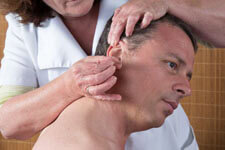
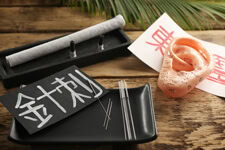
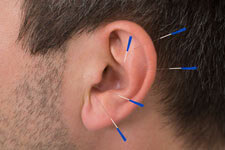
The ear acupuncture practiced today was developed by the French doctor Paul Nogier as a diagnostic and therapeutic method. He presented it for the first time at an acupuncture congress in 1956. However, already 2000 years old Chinese documents describe a reflective connection between the auricle and individual body regions. I use ear acupuncture mainly for the supportive treatment of addiction problems, e.g. for nicotine cessation or weight reduction.
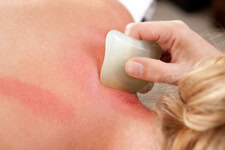
Gua Sha
Gua Sha means “scraping” and is an effective technique of Chinese Medicine to bring stagnant body fluids such as lymph and interstitial fluid back into flow. It is ideal for relieving pain and removing excess metabolic products. Gua Sha is mostly performed in the neck and back area and is especially effective for tension headaches, migraines and painful muscular tension.


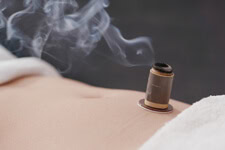
Moxibustion
In moxibustion, acupuncture points are specifically heated with the help of mugwort (Artemisia vulgaris) in order to achieve a particularly intensive healing effect, e.g. in cold or weak conditions. In Chinese medicine the Moxa therapy is equal to acupuncture.

Mycotherapy – Treatment with medicinal mushrooms
Shiitake, Reiki or Cordyceps – many names are already familiar. In Asia, mushrooms have been used for thousands of years to relieve and cure numerous diseases. In the meantime, scientific studies also prove that medicinal mushrooms stabilize the human immune system, inhibit tumors and have a cell renewing effect. In addition, they contain a large number of nutritionally important substances.
In my practice I mainly work with medicinal mushrooms of the company MycoVital, which produce their mushrooms in Germany in organic quality and basically do not use extracts, but mushroom powder of the whole mushroom (fruiting body, mycelium and hyphae).